“Maybe it’s only us”
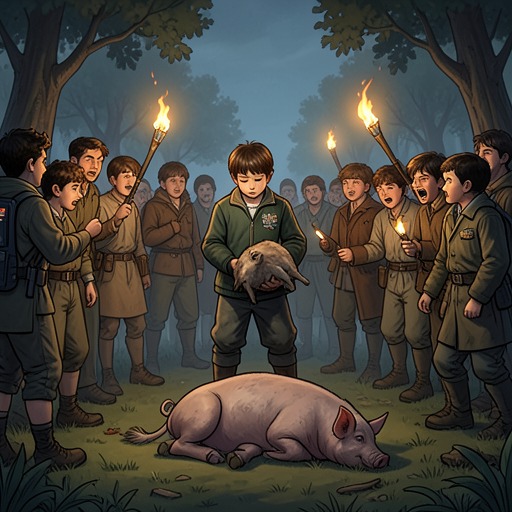
Lord of the Flies“Maybe it’s only us” is Simon’s tentative suggestion that the beast may be found not beyond the boys but within humanity. Its significance lies in the shift it proposes: from fear of an unknown creature to the possibility that the danger belongs to the people themselves. The assembly’s hostile response leaves the insight unheard rather than resolved.
The phrase in the assembly
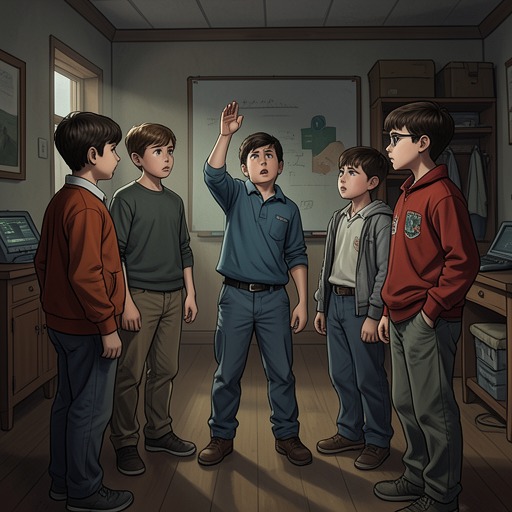
During a meeting already unsettled by arguments about whether a beast could come from the sea, Simon approaches the subject cautiously. He first allows that there may be a beast, then, amid interruptions and cries to take the conch, adds that perhaps “maybe it’s only us.” His uncertainty is explicit: he does not offer a clear account of what the beast is, but struggles toward an explanation of humanity’s essential illness.
Simon then asks what the dirtiest thing is, searching for words to express what he cannot yet articulate. Jack supplies a crude answer, and the hunters erupt with delight. The laughter overwhelms Simon’s attempt to speak; his effort falls apart, and he shrinks back to his seat. The phrase therefore appears at the moment of a failed explanation, not as a conclusion accepted by the group.
Meaning and limits
The suggestion redirects the discussion from whether the beast exists to where its source might lie. Simon does not identify a particular boy as the beast, nor does he claim to have proved that it is real. His hesitant wording keeps the thought open while connecting the feared presence to humanity rather than simply to an animal or supernatural being.
That distinction matters because the assembly has treated fear as a question of identifying an external creature. Simon’s words offer a more troubling possibility: the boys’ own nature may be implicated in what they fear. The scene presents this as an intuition that he cannot fully explain, rather than as a fully developed argument.
Reception and narrative role
The words meet not with reflection but with interruption, insult, and laughter. Ralph tries to secure Simon’s right to speak through the conch, yet the assembly’s noise defeats the procedure meant to protect discussion. Even after Simon’s statement, the boys return to competing explanations, including the possibility that the beast is a ghost. The phrase changes the terms of the debate without persuading the group to follow its implication.
The contrast between Simon’s hesitant search for meaning and the hunters’ delighted response gives the expression its force. It briefly exposes a possibility the assembly cannot hold in view: that fear may point back toward the human beings gathered around the conch. Its rejection makes the thought more significant, while leaving Simon’s meaning unresolved.